Ann Wagner Has Press Releases. Missouri Families Need Answers.
June 17, 2026, 2:58 p.m.
Elizabeth Sparks-Holmes says Ann Wagner's own public record raises fair questions on access, spending, postal service, housing costs, and public safety. Missouri families deserve direct answers, not just statements.
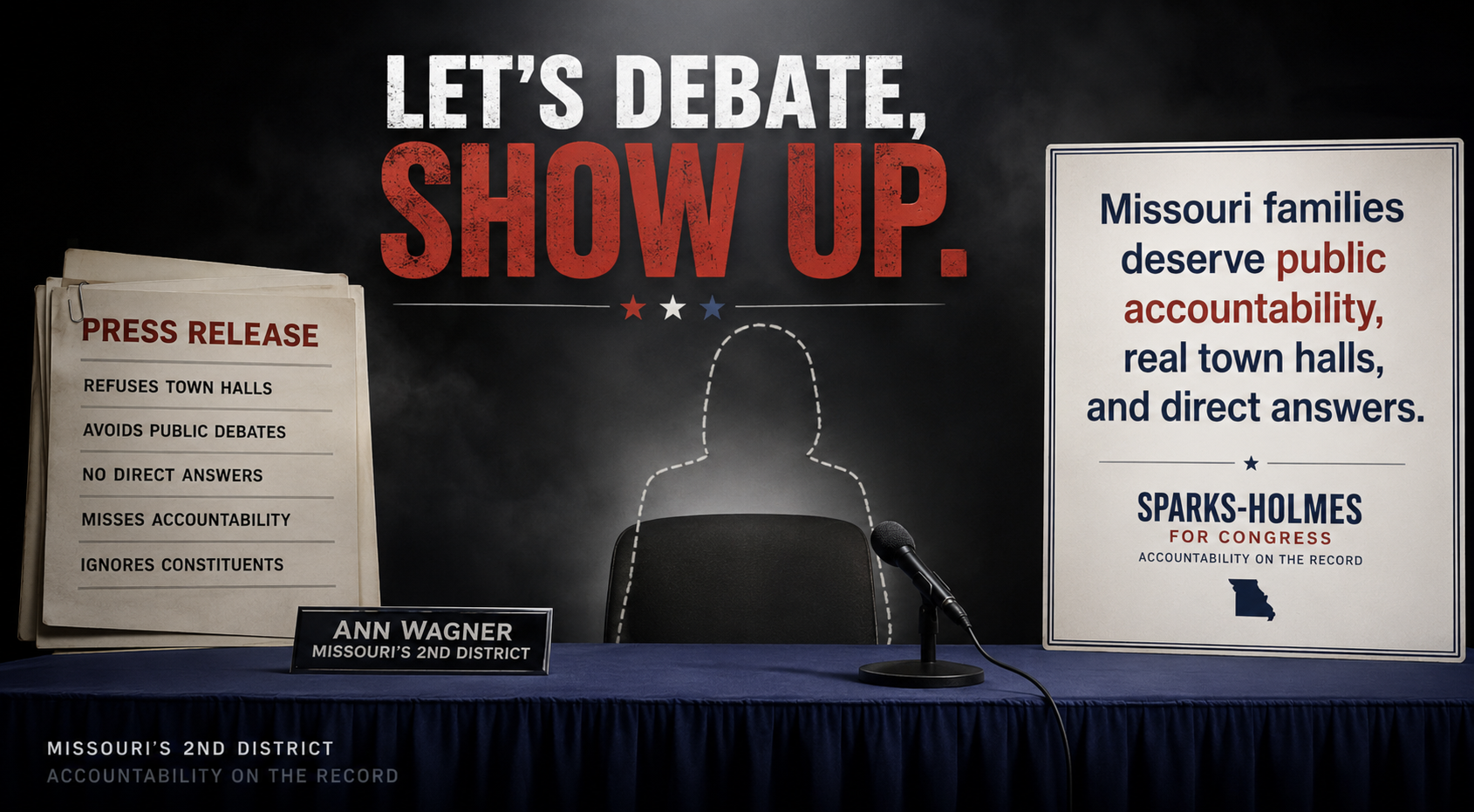
Ann Wagner's official website is full of press releases. Missouri families are asking a harder question: where are the results, and where are the answers?
That is the difference Elizabeth Sparks-Holmes wants this race to expose. A press release can announce a position. It can celebrate a bill. It can criticize an agency. It can sound tough. But a press release does not lower a utility bill, fix a postal delay, hold a public town hall, explain rising debt, stop a counterfeit pill from reaching a teenager, or help a senior figure out whether she can afford to stay in her home.
If Wagner believes her record deserves another term, she should defend it in public. The record itself gives voters at least five fair questions.
Start with access. Wagner's homepage says constituent feedback is important and points voters to contact forms, federal-agency help, district offices, tours, internships, flags, and other services. Those channels matter, but they are not the same as open public accountability. In 2018, PolitiFact examined the criticism that Wagner had not held a public in-person town hall in Missouri's 2nd Congressional District. PolitiFact noted that she had used telephone town halls and private company events, but found no evidence of an in-person public town hall where she took questions from constituents. That should trouble voters. Elizabeth Sparks-Holmes would handle it differently by putting town halls, candidate forums, local interviews, listening sessions, and direct constituent service at the center of the job. A congressional office should not feel like a maze. It should feel reachable.
Second, look at spending. Wagner's own budget page says reining in spending is a top priority and still describes the national debt as more than $20 trillion. That language may have made sense years ago, but the country's fiscal problem has only grown. Families in Missouri's 2nd District cannot run household budgets on old talking points. They have to deal with today's mortgage rates, insurance bills, groceries, gas, property-tax pressure, and utility costs. Sparks-Holmes would bring the argument back to discipline and results: stop treating taxpayers as an unlimited account, force Congress to justify spending in plain English, protect essential commitments, and measure policy by what it does to family budgets.
Third, consider the postal-service problem in the St. Louis region. Wagner and Congressman Wesley Bell introduced the St. Louis Postal Accountability and Reform Act after what their release described as persistent mail delays, operational issues, alleged mail theft, check fraud, and a lack of cooperation from USPS leadership. Wagner also called for an FBI investigation into criminal allegations involving USPS facilities in the region. Those releases are important because they admit what residents already knew: the mail problem has been going on long enough to damage trust. A serious representative should not wait until people are furious and businesses are affected before making accountability visible. Sparks-Holmes would use constituent service as an early-warning system, track federal-agency failures publicly, press for timelines, and report back to voters instead of letting problems become background noise.
Fourth, housing affordability is still squeezing families. Wagner's media center promotes housing legislation and lower-cost promises, but voters deserve to ask what is actually easier today. Are young families finding starter homes? Are seniors able to stay where they built their lives? Are utility, tax, insurance, and repair costs moving in the right direction? Sparks-Holmes' answer is more practical: responsible federal spending, reliable affordable energy, skilled-trades pathways, local control, and housing tools that fit communities instead of federal one-size-fits-all planning. Families do not need a slogan about housing. They need a monthly payment they can survive.
Fifth, public safety requires more than national talking points. Wagner's website highlights law enforcement, border security, and public safety issues. Those concerns are real. But Missouri families are also watching synthetic opioids, counterfeit pills, repeat offenders, mental-health crises, eldercare failures, and unsafe neighborhoods affect daily life. Sparks-Holmes would support law enforcement and victims, enforce immigration law, back strong borders, confront the drug crisis, and still insist that detention facilities and justice systems meet basic standards of dignity and accountability. That is not soft. It is serious.
These are not abstract complaints. They are the difference between holding office and doing the job. If Wagner's record is strong, she should welcome a debate on these questions. If her bills are delivering results, she should explain the results in front of the district. If her office is accessible, she should prove it with open forums and direct answers. If her spending message is current, she should explain why families still feel crushed by the cost of living. If her federal oversight is working, she should show voters which problems have actually been fixed.
Elizabeth Sparks-Holmes is offering a different standard: show up, listen, answer, follow through, and treat Missouri families like the employer, not the audience.
That is why this campaign is about more than one incumbent. It is about what representation is supposed to mean. Missouri's 2nd District deserves a member of Congress who is available before a crisis becomes a headline, who does not confuse announcements with outcomes, and who is willing to sit across from voters and defend every decision.
Wagner has press releases.
Missouri families need answers.